M.Des.
Profile

Performance of Space

  • Culture
  • Layers
  • Mapping
  • Occupant
  • Urbanism
KASHISH KOCHHAR
Mr. Rishi Singhal
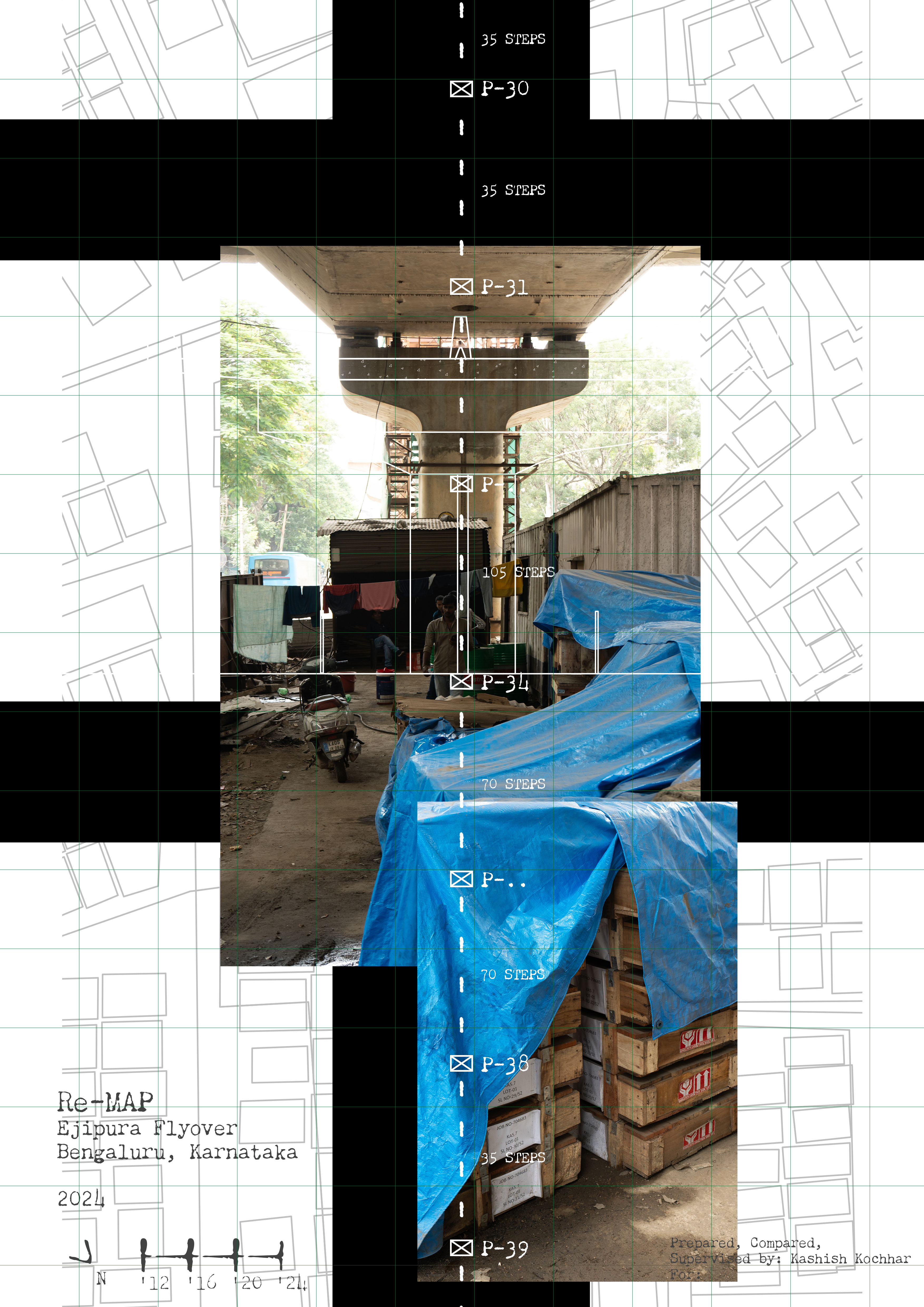

Performance of Space investigates Bangalore’s evolving urban identity through spatial performance. The project traces how the city’s land has been negotiated via indigenous practices, colonial impositions like the Great Trigonometric Survey, and post-colonial adaptations. Colonial mapping turned lived, dynamic landscapes into fixed geometric territories to facilitate domination. However, Bangalore’s land never fully conformed; post-independence growth driven by migration and technology created a city where colonial imprints and spontaneous adaptations intersect. This friction forms the foundation for the "performance of space." Through archival research and visual experimentation, the project re-maps Bangalore by integrating historical maps and botanical surveys with lived narratives. Challenging conventional mapping that prioritizes fixity, these performative "RE-maps" visualize how space is inhabited, reimagined, and contested. Ultimately, the project argues that understanding Bangalore requires moving beyond static documentation to inquire into how space is continually reshaped by its occupants across time, resisting rigid systems of classification.
KASHISH KOCHHAR
KASHISH KOCHHAR
KASHISH KOCHHAR
Profile
KASHISH KOCHHAR
M.Des.
Mr. Rishi Singhal
Performance of Space
Performance of Space investigates Bangalore’s evolving urban identity through spatial performance. The project traces how the city’s land has been negotiated via indigenous practices, colonial impositions like the Great Trigonometric Survey, and post-colonial adaptations. Colonial mapping turned lived, dynamic landscapes into fixed geometric territories to facilitate domination. However, Bangalore’s land never fully conformed; post-independence growth driven by migration and technology created a city where colonial imprints and spontaneous adaptations intersect. This friction forms the foundation for the "performance of space." Through archival research and visual experimentation, the project re-maps Bangalore by integrating historical maps and botanical surveys with lived narratives. Challenging conventional mapping that prioritizes fixity, these performative "RE-maps" visualize how space is inhabited, reimagined, and contested. Ultimately, the project argues that understanding Bangalore requires moving beyond static documentation to inquire into how space is continually reshaped by its occupants across time, resisting rigid systems of classification.
KASHISH KOCHHAR
KASHISH KOCHHAR
KASHISH KOCHHAR